

The Ampersand December 2026
Keeping It Simple
By Adam Pekarsky

Dear Friends and Colleagues,
Sitting in judgment of others is humbling. Especially when, after all these years, I still feel very much judged myself. Every day, every month, every quarter, every year. By clients, colleagues, competitors, and, perhaps most harshly, the weathered, grey-haired guy staring back at me in the mirror.
Last month, I had the privilege of serving as a judge at the Alex Raczenko Pitch Award, part of Calgary's Innovation Week, hosted by Platform Calgary, a non-profit organization dedicated to helping entrepreneurs turn ideas into businesses by connecting them with the people, capital, mentorship, and resources they need to succeed. Our firm is a proud strategic partner, which is how I found myself sitting in a packed theatre on a Monday evening, armed with a scoring rubric and the slightly uncomfortable realization that I was about to pass judgment on ten people with considerably more courage than I had at their stage.
The format was simple. Ten startups. Three minutes each to pitch their business, followed by two minutes of questions from the judges. Convince a roomful of strangers that your idea might just change the world. No pressure.
I've spent the better part of three decades interviewing people for a living, and I can assure you that getting someone to explain what they do in three minutes is no small feat. Getting them to explain why anyone should care is harder still.
The companies represented an impressive cross-section of Calgary's entrepreneurial community. One developing technology to conduct stakeholder interviews at scale. Another using artificial intelligence to simplify personal financial management. A third focused on helping young people develop emotional resilience. Technology to monitor electrical infrastructure and help prevent power outages. On it went. In total, ten different businesses addressing ten different problems. Economic diversification blooming in real time.
When the pitches concluded, the judges retired to deliberate. New to this judging thing, I was heartened to discover that my first choice was also the first choice of my fellow judges: Agrivanna. Full disclosure, I am not, by any definition, an agricultural expert. My understanding of livestock management begins and ends somewhere between knowing which end of a cow eats and which end produces fertilizer. But I do understand that Agrivanna helps ranchers manage their livestock and grazing operations more efficiently using AI-powered technology to make better decisions about their herds and land. Got it.
The Ampersand Unplugged
The Ampersand podcast explores issues that impact our community, businesses of all shapes and sizes and challenges impacting human capital and the human condition.
The Ampersand Delivered
Subscribe to The Ampersand and receive instant access to thought provoking articles on the human condition, the motivators & deterrents, the reason some excel while others fail, and the dirty little secret that the bottom 90% of the class usually do better than the top 10%. With over 11,000 subscribers and 200+ posts and counting this is one newsletter you won’t be able to delete from your inbox.
SubscribeThe problem was clear. The solution was clear. The customer was obvious. Even a city boy like me could see the opportunity. That, to me, was the difference between their pitch and the others. Not necessarily the most complicated technology or the most ambitious financial projections, but a clear explanation of a problem and a solution.
It was a useful reminder of something my generation learned long before artificial intelligence became the answer to seemingly every question. KISS. Keep It Simple, Stupid. An inelegant expression that has aged pretty well. Certain of the other presentations, impressive though they were, tended to disappear down jargon-laden rabbit holes. Total addressable markets. Customer acquisition costs. Seed rounds. Series A. Hockey-stick growth projections. Pre-money valuations. Post-money valuations. Yada yada. By the end of the evening, I was in an MBA fever dream of proprietary AI-enabled, vertically integrated, cloud-native, blockchain-adjacent solutions that were going to leverage synergies, unlock exponential value, and disrupt the paradigm of disruption itself. Cool, bro.
Of course, I'm hardly immune to the very thing I was judging. I pitch for a living. I know my business better than my prospective client does, so my challenge is to explain it to them simply, stupid. Like that Far Side cartoon. “What we say to dogs: Okay, Ginger, I’ve had it! You stay out of the garbage! Understand, Ginger? What our dogs hear: blah blah Ginger blah blah blah blah blah Ginger?” (Note to self: Does my pitch sound like that?)
In fairness, I'm sure those concepts are important. But before we get too excited about your projected enterprise valuation in 2031, could someone please explain what you actually do? And who is going to pay you to do it?
Call me old-fashioned, but I still believe those are fairly important questions. For all the technological sophistication, finance jargon, and start-up gumption on display, the fundamentals of building a business haven't changed much. Identify a problem. Explain it clearly. Find someone willing to pay for the solution. Solve it. And then survive long enough to prove you were right.
Clarity remains an underrated competitive advantage. The ability to explain a complicated idea simply is not evidence that the idea is unsophisticated. Quite the opposite. Evidence, in fact, that the person explaining it understands it exceptionally well. The students in my law school class, some 30 years ago, who got the best grades were invariably the ones who filled out half of one exam book and left the room a third of the way into the allotted time while the rest of us filled books upon books, like so many monkeys hoping to conjure the full works of Shakespeare if we just. Wrote. Enough. Words.
As I watched these entrepreneurs take their turns on stage, I found myself drifting back not to law school in the mid-1990s, but to 2009, when I launched my own business.
Sitting in the basement of my house, trying to figure out how to print invitations to my firm's ‘launch party.’ Upside down? Right side up? Face in? Face out? Every attempt produced another beautifully printed invitation on the wrong side of the very pricey cardstock. Not a nickel of revenue and I was blowing through my fancy paper budget without managing to print a single invite. Gasp. Inverted hockey stick!
There was no sophisticated pitch deck. No venture capital. No accelerator program. No advisory board populated by successful founders who had been there before. No Platform Calgary. Just me, an irrational amount of optimism, a healthy dose of anxiety, and a tray of appetizers at a local restaurant where I hoped enough people would show up to make the whole exercise seem legitimate.
Approaching two decades later, our firm has grown and evolved. We've enjoyed some terrific wins and suffered some painful losses. There have been moments of extraordinary pride and moments when I would have happily traded the whole entrepreneurial adventure for a nice, predictable paycheque and someone else's problem to solve.
But I wouldn't trade the journey. Not the scars, the grey hairs, or even the mistakes.
Which brings me back to those ten entrepreneurs. I found myself experiencing two competing emotions that night. The first was genuine admiration. The second was a distinctly middle-aged urge to approach each of them, put a hand on their shoulder and say, "You have absolutely no idea what you're getting yourself into."
Because they don't. How could they? They don't yet know about the customer who promises to sign and then disappears, the employee who resigns at the worst possible moment. They don't know how lonely leadership can sometimes feel, how difficult it is to make decisions when there is no obviously correct answer. How much of entrepreneurship involves projecting confidence while privately wondering whether you have the faintest idea what you're doing.
But here's what else they don't (yet) know. They don't know the exhilaration of landing that first major customer, the pride of watching a colleague grow into a leader, or the quiet pleasure of realizing that something which once existed only in their imagination has become a real enterprise supporting real people and their families. They don't know the extraordinary feeling of looking around a room seventeen years later and realizing that the business they started is no longer just about them.
And that's pretty freaking cool.
Of course, not every one of those ten companies will succeed. But I would be reluctant to describe those whose businesses don't survive as failures. There is value in having the courage to try, in learning how to build something, in discovering what doesn't work, and in finding the resolve to begin again. Yes, we celebrate the winners, as we should. But I sometimes wonder whether we sufficiently celebrate the people who have the courage to enter the arena in the first place.
Which is why I came away from the event feeling particularly grateful for the work being done by Platform Calgary. Their team has created something very cool. Not simply a building, an event, or a collection of programs, but a place where entrepreneurs can find encouragement, connections and, perhaps most importantly, one another.
I think about how much I would have appreciated something like that in 2009. Someone to challenge my assumptions, introduce me to prospective clients, someone who knew how to operate a printer.
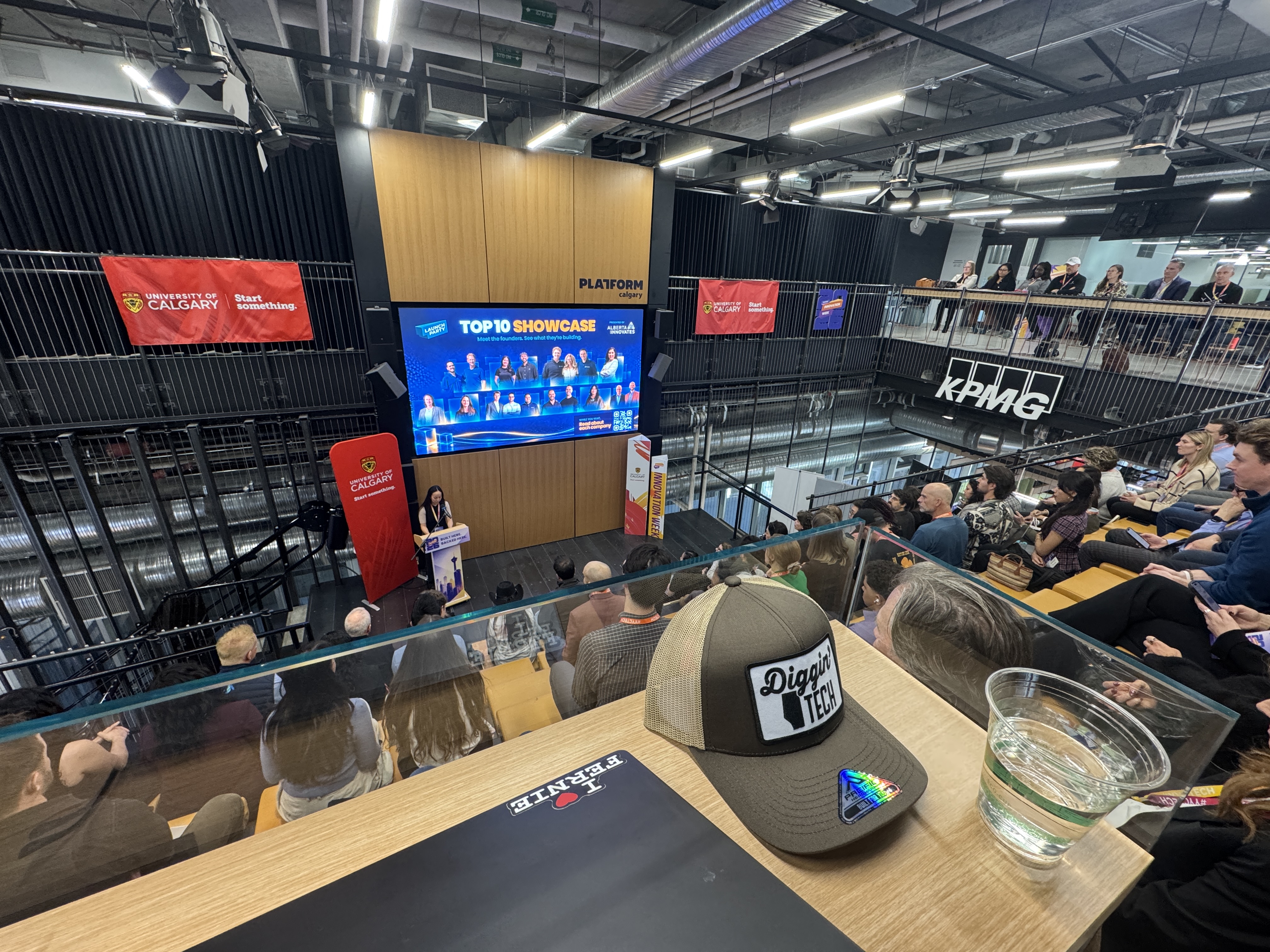
Calgary has always had a complicated relationship with its own entrepreneurial mythology. We love our Wild West narrative. Sometimes we overdo it. But there is something genuinely admirable about the entrepreneurial spirit that has shaped this city and province, and on that Monday evening, I saw it in its purest form. Not in a slick annual report or a slick politician's speech, but in a packed theatre where ten entrepreneurs stood up, one after another, and asked an audience to believe in something that did not yet fully exist. There was no swagger. Just courage, possibility, and a roomful of people cheering them on.
Calgary has always had a complicated relationship with its own entrepreneurial mythology. We love our Wild West narrative. Sometimes we overdo it. But there is something genuinely admirable about the entrepreneurial spirit that has shaped this city and province, and on that Monday evening, I saw it in its purest form. Not in a slick annual report or a slick politician's speech, but in a packed theatre where ten entrepreneurs stood up, one after another, and asked an audience to believe in something that did not yet fully exist. There was no swagger. Just courage, possibility, and a roomful of people cheering them on.
As 2026 draws to a close, I find myself reflecting on what my journey has taught me. And perhaps the most important lesson is that nobody ever really has it all figured out. The difference between the entrepreneur just starting out and the one seventeen years down the road isn't necessarily wisdom. Sometimes it's simply the accumulation of enough mistakes to recognize a few of them before making them again. And even then, no guarantees.
All those years ago, I was in my basement, fighting with a printer and preparing to introduce a business that existed largely in my imagination. On that Monday in November, I sat in a theatre watching ten people do essentially the same thing. Different technology. Different industries. Different generations. Same leap of faith.
I went there to judge their pitches. I came away thinking about my own.
Agrivanna helps ranchers manage their herds and their land. We help great companies attract and retain great people. No hockey-stick projections. No vertically integrated, cloud-native, blockchain-adjacent anything.
Just a problem, a solution, and someone willing to pay for it.
Got it?
Regards,
Adam